Introduction
Survival after hematopoietic stem cell transplantation (HSCT) for acquired aplastic anemia (AA) has improved significantly in recent decades.1,2 Sustained hematopoietic recovery is pivotal to the success of HSCT in AA. However, clinicians have noted that even when patients achieve initial hematopoietic reconstitution and retain complete donor-derived hematopoietic cells, they may subsequently develop refractory thrombocytopenia.3,4 This phenomenon, known as secondary failure of platelet recovery (SFPR), affects 12-26% of patients post-transplantation according to previous reports.5–7 Patients with SFPR lose their initial platelet reconstitution, which leads to increased risks of severe bleeding events and other life-threatening complications, or requirement for transfusions after transplantation. Current therapeutic strategies for SFPR are constrained, and the associated prognosis remains poor.
Several risk factors have been associated with SFPR after allogeneic HSCT, including transplants from unrelated donors, graft-versus-host disease (GVHD) prophylaxis regimens, severe acute GVHD (aGVHD), conditioning involving busulfan, cyclophosphamide and total body irradiation, stem cell dosage, and infections—particularly cytomegalovirus (CMV) reactivation.5,6 However, data on SFPR after allogeneic HSCT (allo-HSCT) in pediatric AA patients are still limited.
This study aims to investigate the incidence, clinical management, outcomes, and risk factors associated with SFPR in pediatric patients with AA post-HSCT.
Materials and Methods
Patient Selection
In this retrospective analysis, we reviewed a consecutive series of 86 acquired AA children who underwent allo-HSCT as their first HSCT at the Institute of Hematology and Blood Diseases Hospital in Tianjin, China, from December 2017 to November 2023. All pediatric patients’ guardians gave informed consent before participation in this study. Patients who developed graft failure after allo-HSCT (n=5) or died of any cause within 30 days post-transplantation without hematopoietic reconstitution (n=3) were excluded from further analysis. Consequently, the remaining cohort, comprising 78 patients, was utilized to estimate the cumulative incidence of secondary failure of platelet recovery (SFPR).
Definitions
The timeline for SFPR was calculated from the date of HSCT to the date of clinical diagnosis. SFPR was defined as the first of seven consecutive days of platelet counts <20 ×109/L or a requirement of platelet transfusions within 7 days after primary platelet recovery was achieved. Patients who had graft rejection or disease relapse within 30 days after the onset of SFPR were regarded as those without SFPR, in accordance with previous studies.7 Neutrophil engraftment was identified as the first of three consecutive days with an absolute neutrophil count exceeding 0.5 ×10⁹/L, while platelet engraftment was defined as the first of seven consecutive days with an unsupported platelet count above 20 ×109/L. Cytomegalovirus (CMV) and Epstein-Barr virus (EBV) DNAemia was defined as the presence of >1000 DNA copies/mL in blood by quantitative polymerase chain reaction (PCR) assays.8,9 A human leukocyte antigen (HLA) mismatch was identified as having at least one antigen discrepancy between the donor and recipient. Both aGVHD and chronic GVHD (cGVHD) were diagnosed and graded according to established criteria.10 Body mass index (BMI) was categorized according to World Health Organization BMI-for-age standards. Overall survival (OS) was calculated as the period from the date of transplantation to the date of death from any cause or the last follow-up point.
Statistical Analysis
The last follow-up for all survivors was conducted on February 25th, 2024. All clinical data were analyzed utilizing R software (version 4.4.1). Continuous variables were summarized as median (range) and compared using the Mann-Whitney U test, while categorical variables were presented as counts and percentages and compared using the chi-square test or Fisher’s exact test. Univariable analysis was performed based on logistic regression models, and potential risk factors (p-value <0.10) were further analyzed in multivariable analysis. The final model was determined using stepwise multiple logistic regression with the “MASS” package.11 Furthermore, the Kaplan-Meier method was employed to estimate survival curves. All statistical tests were two-tailed, and a p-value <0.05 was considered to indicate statistical significance. The cumulative incidence rate (CIR) of SFPR was calculated using Gray’s method, considering death without SFPR as a competing event.
Results
Characteristics of patients with SFPR or non-SFPR
A total of 78 pediatric patients with acquired AA who underwent allo-HSCT were included. The median age was 8 (range, 2-17) years, and 60.2% were male. Pre-transplant, 52.6% were diagnosed with very severe AA (VSAA). The donor types for HSCT were as follows: 59.0% received grafts from haploidentical donors (Haplo), 28.2% from matched sibling donors (MSD), and 12.8% from unrelated umbilical cord blood (UCB). Additional general characteristics of the patients are presented in Table 1.
Incidence of SFPR and other clinical events before SFPR onset
The median time to SFPR was 2 (range, 1-5) months post-transplantation (Supplemental Figure 1). The 1-year CIR of SFPR was 11.6% (95% CI: 6.2%-21.1%). Among the SFPR cohort, the median times to neutrophil and platelet engraftment were both 14 days post-transplantation. Four patients (44.4%) had developed grades III-IV aGVHD prior to the onset of SFPR. Additionally, 3 patients (33.3%) experienced CMV reactivation, transplantation-associated thrombotic microangiopathy (TA-TMA), and hemorrhagic cystitis (HC), respectively. Furthermore, 2 individuals had evidence of EBV activation and early bloodstream infection, respectively. Full cohort characteristics are detailed in Table 2.
Risk Factors for SFPR
We subsequently explored whether patients’ characteristics, HSCT program, and early post-transplantation complications could predict the incidence of SFPR. The results of the univariate logistic regression analysis for SFPR are presented in Supplementary Table 1. Subsequently, we selected indicators with P-values < 0.1 for inclusion in the multivariate analysis. On the latter, age, BMI and Ⅲ-Ⅳ aGVHD (p-value <0.05) were identified as the most significant predictors for SFPR (Table 3). These findings suggest that special attention should be given to patients with abnormal BMI and those who have experienced severe aGVHD, as they may be at higher risk for the development of SFPR.
Managements and outcomes of SFPR
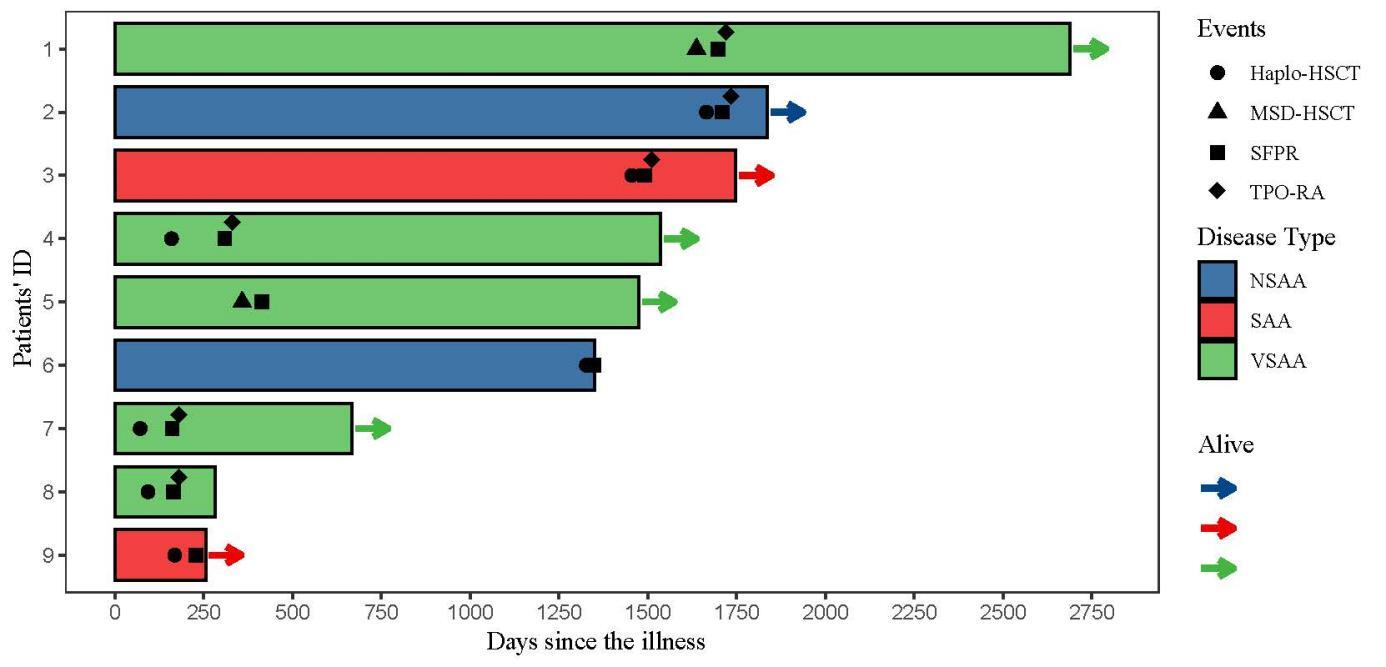
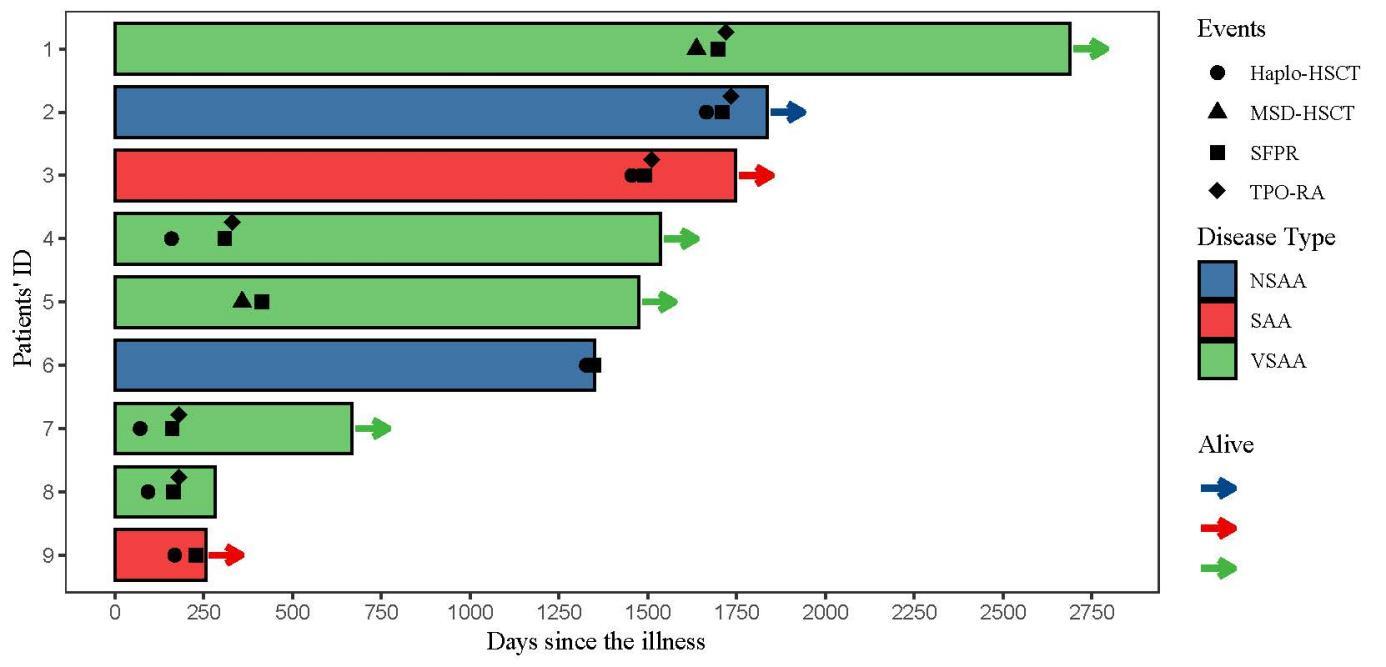
Treatment strategies for the 9 patients with SFPR, included platelet transfusions, thrombopoietin receptor agonists (TPO-RAs), recombinant human thrombopoietin (rhTPO), and glucocorticosteroid (Shown in Table 4). Ultimately, 4 patients (patients 3, 4, 5, and 7) achieved full platelet count recovery. In 2 cases (patients 2 and 9), the interventions resulted in a state of transfusion independence, with absolute platelet values consistently above 20 × 109L, although not returning to the normal range. Patient 1 did not experience recovery and remained dependent on platelet transfusions. Two patients (nos. 6 and 8) succumbed to severe pneumonia. The treatment outcomes are shown in Supplemental Figure 1.
Among the five patients treated with avatrombopag and the one treated with eltrombopag, three regained normal platelet counts, and one became independent of platelet transfusions, yielding an overall response rate of 66.6%.
Impact of SFPR on OS
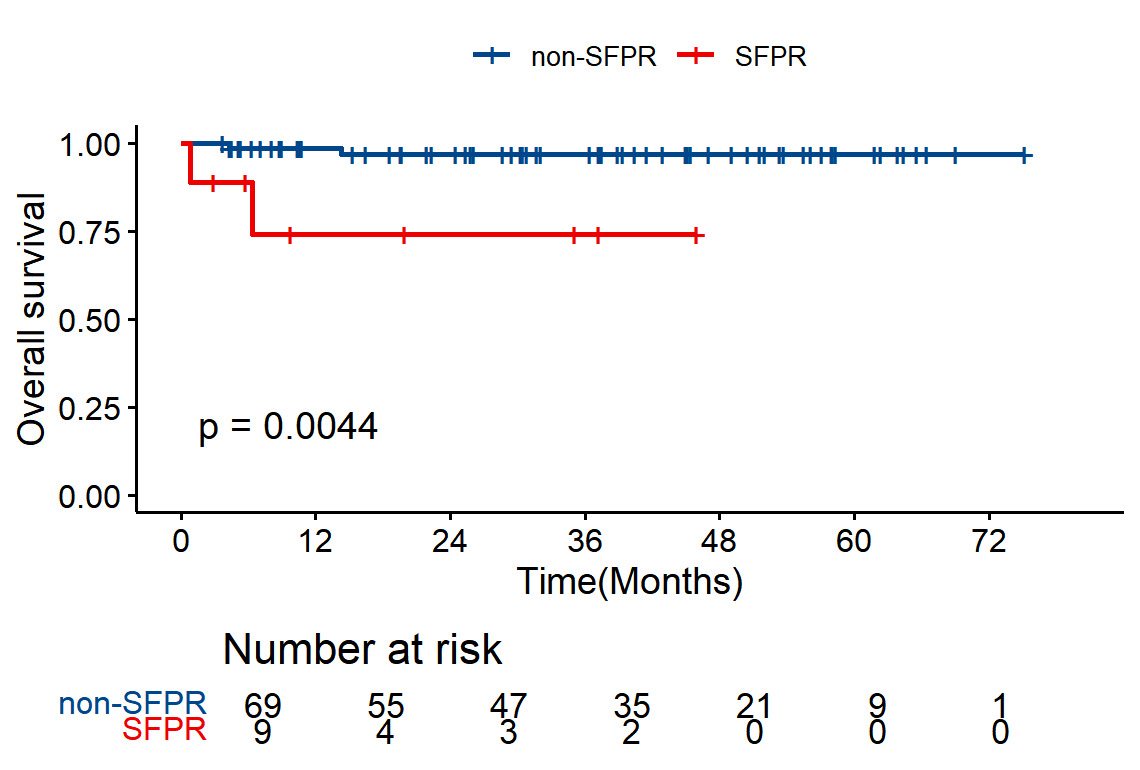
With a median follow-up period of 32 (range, 0.8 to 75.1) months), the 2-year OS rate for the entire cohort was 94.3% (95% CI 89.1-99.9). Notably, a significant difference in OS was observed between patients with and without SFPR (74.1% versus 96.7%; p < 0.005) (Figure 1).
Discussion
Acquired AA in children is a severe hematological disorder that seriously not only endangers children’s physical and mental health, but also imposes a heavy economic burden on families and society, while consuming substantial public health resources. In the case of SAA/VSAA and transfusion-dependent AA, allo-HSCT is a key therapeutic option. In our studies, the 2-year OS rate for the whole cohort was 94.3% (95% CI 89.1-99.9), which indicates a marked improvement in prognosis for pediatric patients with AA.
SFPR, as an important complication following HSCT, is associated with life-threatening hemorrhage, negatively impacting the quality of survival in pediatric patients. Previous research has mostly focused on adult allogeneic transplants or autologous transplants,6 with only a few reports addressing SFPR in the context of pediatric allo-HSCT. In our study, 11.6% (9/78) of the children developed SFPR (95% CI: 6.2%-21.1%) within 1-5 months post-transplantation. This incidence appears to be slightly lower than that observed in adults, which ranges from 12% to 26%.5–7 Although older age in our cohort seems to correlate with a higher risk of SFPR, this observation does not firmly establish that age plays a significant role in the incidence of SFPR, given the limited studies comparing different age groups.
Importantly, the etiology of SFPR is not yet fully understood. Some specialists12 have suggested an association between SFPR and aGVHD. Research has shown that patients with SFPR/aGVHD have significantly higher levels of inflammatory cytokines IL-2R and TNF-R1, indicating a dysregulated immune response. Additionally, pathways critical to hematopoiesis and immune responses are underexpressed in CD34+ cells isolated from SFPR/aGVHD patients, suggesting a direct impact on hematopoietic function. Our multifactorial analyses seem to support these findings, highlighting the need for further investigation into the relationship between SFPR and aGVHD. Interestingly, we identified abnormal BMI as a potential risk factor for the development of SFPR. Previous research has reported13,14 that both obesity and low BMI can increase the risk of aGVHD after post-transplantation. In our study, 7/9 patients with SFPR had abnormal BMIs (3 cases of overweight, 2 cases of obesity, and 2 cases of thinness), with only 2 cases simultaneously developing grades Ⅲ-Ⅳ aGVHD. This suggests a complex interplay between BMI, aGVHD, and SFPR that warrants further exploration. As for CMV reactivation, contrary to a previous report by Zhao et al.,15 which suggested a higher incidence of CMV reactivation in SFPR patients, our findings indicate that out of 9 patients in the SFPR group, only 3 had CMV with an average viral load of 5707.67 CMV DNA copies/mL in the serum. This was lower than the average of 8095.67 CMV DNA copies/mL observed in 27 non-SFPR patients with CMV reactivation, suggesting that the role of CMV in SFPR may be more complex than previously thought.
In recent years, TPO-RA is becoming increasingly important in the treatment of patients who develop thrombocytopenia due to various causes.3,16–18 Among the 6/9 patients with SFPR, who received TPO-RA monotherapy or combination therapy, the overall response rate was 66.6%. As reported,19 rhTPO has also demonstrated efficacy in the treatment of SFPR. In our cohort, platelet counts gradually returned to normal in one patient who received rhTPO and methylprednisolone. However, restricted by the limited number of cases, we are unable to compare the efficacy of different treatment regimens. Further in-depth mechanistic studies are needed to guide us to more efficient clinical treatments.
The present study encompasses several limitations. The single-center retrospective design and limited cohort size (particularly the low SFPR incidence yielding few positive cases) may compromise statistical power and increase the risk of model overfitting. Multivariable regression analyses were potentially limited by an inadequate events-per-variable (EPV) ratio, raising concerns about parameter estimate stability. Finally, the absence of external validation restricts generalization of findings. While univariate analyses were conducted to mitigate these constraints, confirmation through larger prospective cohorts remains essential. Future studies with larger numbers of patients are needed to validate our findings and to explore the associations identified in this preliminary analysis.
In summary, our findings revealed that 11.6% of pediatric patients who underwent transplantation developed SFPR which was not due to relapse or graft rejection. We identified abnormal BMI and severe aGVHD were significant risk factors associated with SFPR. Additionally, SFPR had a significant adverse effect on OS. Therefore, novel approaches to determine the underlying etiology of SFPR will be required to improve the outcome of patients with SFPR.
Acknowledgments
The authors wish to thank the patients and to express their gratitude for the financial support provided by the National Natural Science Foundation of China (Project Number: 82070201).
Authors’ Contribution - CRediT
Conceptualization: Ye Guo; Methodology: Yuanyuan Ren, Lipeng Liu; Formal analysis and investigation: Yue Shang; Writing - original draft preparation: Yue Shang; Writing - review and editing: Xin Wang, Chaoqian Jiang, Xia Chen, Yang Wan, Aoli Zhang, Xiaoyan Zhang, Fang Liu, Li Zhang, Yumei Chen, Yao Zou, Xiaojuan Chen, Wenyu Yang; Funding acquisition: Ye Guo ; Resources: Xiaofan Zhu, Ye Guo; Supervision: Ye Guo
Competing of Interest – COPE
No competing interests were disclosed.
Ethical Conduct Approval – Helsinki – IACUC
The study design and methods complied with the Declaration of Helsinki and were approved by the Ethics Committee and Institutional Review Board of the Institute of Hematology and Blood Diseases Hospital, Chinese Academy of Medical Sciences & Peking Union Medical College.
Informed Consent Statement
All authors and institutions have confirmed this manuscript for publication.
Data Availability Statement
All are available upon reasonable request.